
Foundation University School of Health Sciences (FUSH) is a comprehensive academic and healthcare entity that brings together multiple institutions under one integrated system. It comprises the University Secretariat, Foundation University Medical College (FUMC), Foundation University College of Dentistry & Hospital (FUCD&H), Foundation University College of Physical Therapy (FUCP), Foundation University College of Nursing (FUCN), and Foundation University College of Allied Health Sciences (FUCAHS). Collectively, these institutions contribute to a multidisciplinary approach to education, research, and professional training in the health sciences.
An essential component of FUSH is Fauji Foundation Hospital (FFH), which serves as a primary teaching and training hospital. FFH provides extensive clinical exposure and hands-on learning opportunities for students of FUMC, FUCN, FUCAHS, and FUCP. The close integration of academic institutions with a fully functional teaching hospital ensures that students gain practical experience in real healthcare settings while being guided by experienced faculty and clinicians.
Through this collaborative structure, FUSH promotes excellence in medical and allied health education, encourages interprofessional learning, and supports the development of competent, ethical, and skilled healthcare professionals. The unified framework enables effective coordination between education and clinical practice, ultimately contributing to improved patient care and advancing the healthcare system at both national and international levels.

director fush
maj gen prof. dr. qudrat ullah malik, hi(m)(retd)
Director's Message
Foundation University School of Health Sciences (FUSH) is a cluster of faculties of Medicine, Dentistry, Rehabilitation Sciences and Nursing housed in purpose built infra structures. These colleges have produced high quality graduates who are serving nationally and internationally with pride and dignity. We have engaged highly qualified and dedicated faculty who are well conversant with evolving trends in medical education and possess adequate skills to transform young scholars in to future leaders in health care. In addition to formal education, we focus on promoting discipline, ethics , social values and communication skills. These colleges have designed curricula aimed at producing community oriented graduates with ability to meet future challenges of rapidly changing health care spectrum. I am sure you would thoroughly enjoy your life in this campus and will contribute in making these institutes even greater.


Foundation University Medical College
Foundation University Medical College (FUMC) was established in the year 2000 and has since developed into a well-recognized institution for medical education and training. The college admits 150 students annually, maintaining a balanced student–faculty ratio to support quality education and effective learning. FUMC is accredited by the College of Physicians and Surgeons Pakistan (CPSP) and is approved for FCPS Part II training, reflecting its strong clinical and academic standards.
The college is located in a purpose-built, modern campus designed to meet the academic, clinical, and residential needs of students and faculty. Separate, well-maintained hostels for male and female students are situated within the same premises, providing a safe, comfortable, and convenient living environment that supports academic focus and personal well-being.
FUMC holds international recognition and visibility through its listing in the International Medical Education Directory (IMED). The institution is also a member of the International Association of Medical Regulatory Authorities (IAMRA) and participates in the Visiting Student Learning Opportunities (VSLO) program, enabling students to access global learning and clinical exposure. Through its commitment to excellence in education, training, and international collaboration, Foundation University Medical College continues to play a vital role in producing competent, skilled, and ethically driven medical professionals who are well prepared to meet national and global healthcare challenges.

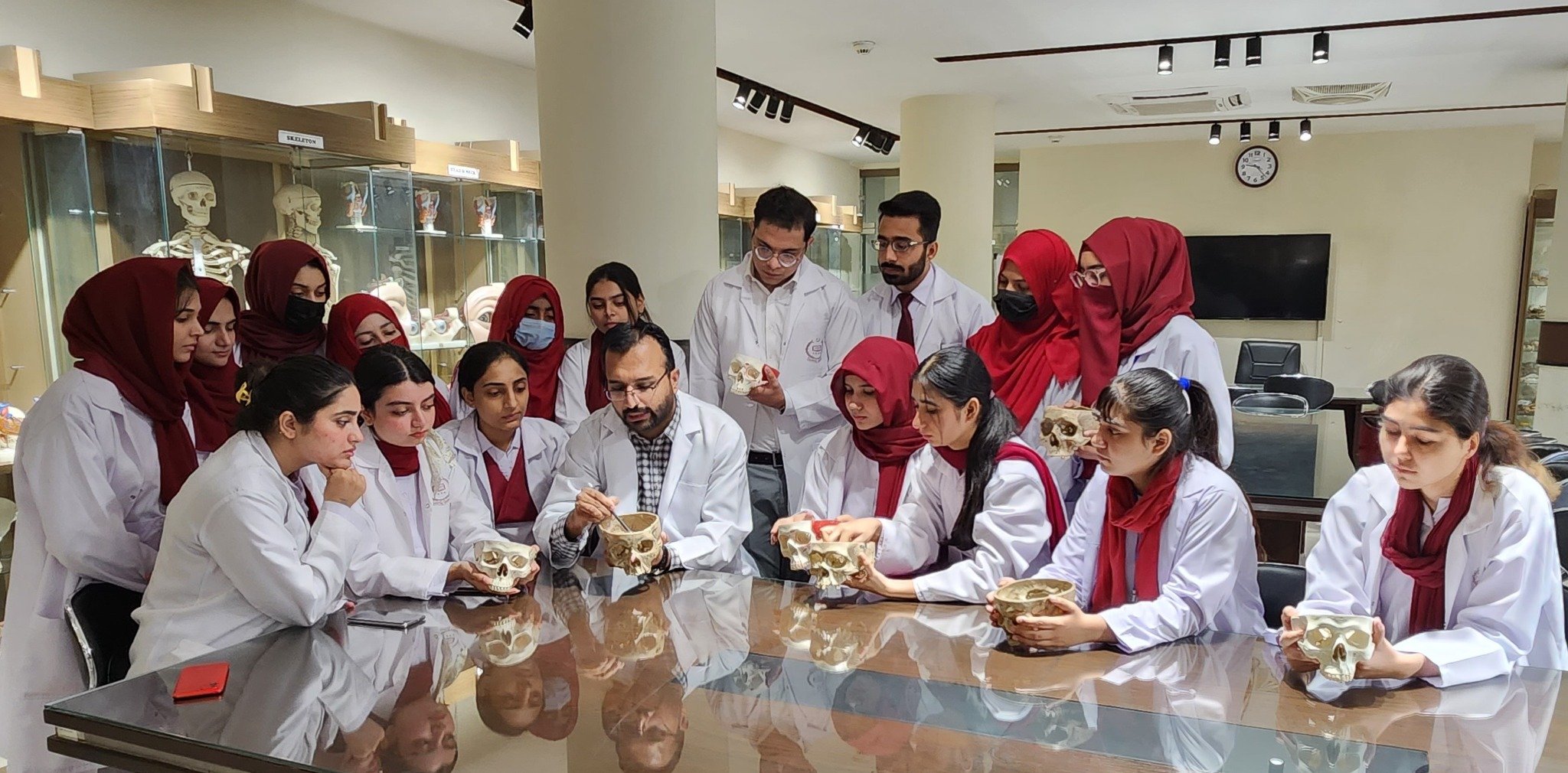
Bachelor of Medicine and Bachelor of Surgery (MBBS)
The Bachelor of Medicine and Bachelor of Surgery (MBBS) program at Foundation University Medical College (FUMC) is structured in accordance with contemporary educational standards and international medical training practices. The curriculum has been thoughtfully developed to reflect modern advancements in medical science and healthcare delivery, ensuring that students receive a well-rounded and up-to-date medical education. Emphasis is placed on integrating theoretical knowledge with practical clinical skills, enabling students to develop critical thinking, problem-solving abilities, and professional competence.
The program is carefully designed to align with the evolving needs of the healthcare sector and the demands of the future medical workforce. By incorporating innovative teaching methodologies, clinical exposure, and evidence-based learning, the MBBS program prepares graduates to adapt to rapid changes in medical technology and patient care. Additionally, the curriculum focuses on producing competent, ethical, and socially responsible physicians who are capable of working effectively in diverse healthcare settings.
Through this forward-looking approach, FUMC aims to equip its graduates with the knowledge, skills, and attitudes required to successfully meet future challenges in medicine. The program not only addresses current healthcare needs but also anticipates emerging trends, ensuring that graduates are well-prepared to contribute meaningfully to the medical profession and the overall improvement of public health.
The rationale behind FUMC curriculum is that the student, on graduation, acquires competencies defined in the curriculum to practice both nationally and internationally. The curriculum is designed in context of the prevailing conditions both in education and health delivery restraints nationally, and making it as close to International Standards as possible.
Preamble
The content of this 5-year curriculum is in accordance with the curricular document of Pakistan Medical and Dental Council, and Higher Education Commission of Pakistan. It has been arranged into modules in a spiral manner with both horizontal and vertical integration.
The curricular document defines the terminal objectives or outcomes. The LOs written are in line with the Learning outcomes mentioned in the PM&DC curricular document, for developing a Seven Star Doctor, Tomorrow’s Doctor 2011 of General Medical Council of UK, Scottish Doctor and Five Star Doctor of World Health Organization.
The main emphasis is on the desired knowledge, skills, attitudes, community health and health advocacy, research and lifelong learning required from successful graduates of FUMC to practice as a safe and professional doctor.

Outcomes
The outcomes of FUMC are in five main domains.
Professionalism and Ethics (Attitude)
1. FUMC Graduate will be able to demonstrate acquired attributes of professionalism and ethical values. The graduate will be able to:
Know about ethical guidelines of regulatory authority including Best Medical Practices.
Demonstrate awareness of his/her responsibilities as a doctor towards care of the patient.
Displays high standard of Ethical Values including politeness, sympathetic, sacrifice for others, respect to colleagues and patients, obedience to superiors, and rights of the society.
Demonstrates knowledge of national and International laws related to health care, patient rights, death certification and forensic practice.
Work effectively as a member of multidisciplinary team involved in health care delivery.
Demonstrates ability to build a team, assigning roles to team members and attributes of good team leader.
Knowledge
2. FUMC Graduate will be able to demonstrate fundamental knowledge of all medical subjects and is able to correlate and apply this knowledge to medical practice. The graduate will be able to:
Correlate normal structure and functions of the human body.
Differentiate and explain between normal and abnormal structure and function.
Differentiate between normal and abnormal human behavior.
Understand effects of development, growth and aging.
Demonstrates thorough knowledge of substances, include local remedies and alternate medical provisions used in the treatment and prevention of diseases.
Applies this knowledge to prevent and treat common clinical conditions.
Know genetic abnormalities in the populations.
Make observations of resulting clinical phenomena accurately.
Select and justify investigations for common structural and functional abnormalities.
Performs critical analyses of clinical data accurately.
Develops problem solving and critical thinking skills.
Skill
3. FUMC Graduate will be able to demonstrate skills required for identification and management of common clinical conditions. The graduate will be able to:
Take detailed history.
Perform full physical and psychological examination.
Formulate provisional diagnoses.
Order appropriate investigations.
Make a final diagnosis on the basis of history, examination and investigations.
Make appropriate treatment plan using principles of evidence based medicine.
Select most appropriate and cost effective drugs.
Discuss treatment plan and treatment modalities with the patient and caring relative(s) including other options and possible outcomes.
Communicate clearly, effectively and sensitively his plan of management of the patient and all aspects of disease and outcomes of treatment.
To provide immediate care, including first aid, resuscitation and life support, in medical emergencies.
Recognize and work within limits of his competence and decide to refer to appropriate specialist where required.
Carry out diagnostic and therapeutic practical procedures safely and effectively.
Record, collect and maintain all information relevant to the patient observing the requirements of confidentiality.
Community Health and Health advocacy
4. FUMC Graduate will be able demonstrate knowledge of Community Health, Policy formulation and Governance. The graduate will be able to:
Demonstrate knowledge of common health issues of the community including those of communicable diseases, environmental diseases, genetic diseases and non-communicable diseases.
Discuss basic principles of improvement of Health of the Community.
Discuss the principles of development of health and health service policy.
Discuss the role of nutrition in health.
Demonstrates knowledge of Socio-cultural and Economic factors that influence the health of community.
Demonstrates knowledge of addressing these issues and formulate policies and methods for this purpose.
Know global perspective of health determinants and health care delivery.
Discuss Collaborative Health promotion and prevention of disease programmes.
Demonstrates attributes of a good manager and a leader.
Research and Lifelong learning
5. FUMC Graduate will be able to demonstrate attributes of a Scientist, Scholar and a lifelong learner. The graduate will be able to:
Use all electronic means of data search, storage and retrieval.
Critically appraise the results of published data on etiology, pathology treatment and prognosis of diseases.
Formulate research questions and design appropriate studies, experiments and trials to address these questions.
Collect published evidence in support of or against his findings and report his findings as a publishable paper.
Understands ethical issues involved in medical research.
Communicate to the audience results of his studies and summary of his knowledge and experiences in conferences, seminars and symposia.
Continuously acquire new knowledge, ensure that the patient receives best care and adapts to changing circumstances.
Maintains balance between personal and professional life
Develops portfolio of reflections and achievements.
Contribute towards feedback and student mentoring.
