
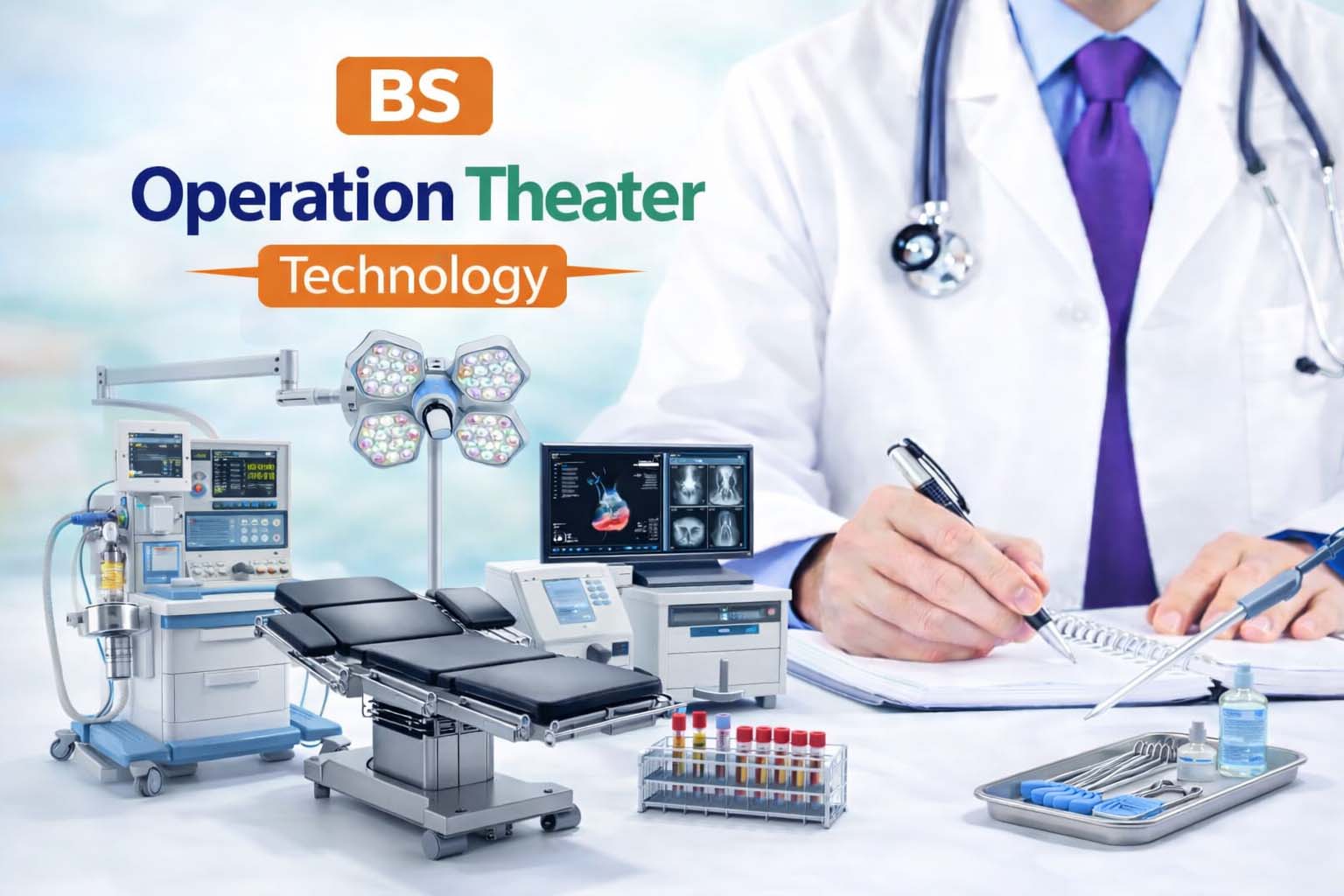
4 Years Bachelor Program
‘‘Your skills: The surgeon’s strength. The patient’s hope.”
“Be the precision behind every successful surgery.”
The Bachelor of Science in Operation Theater Technology (BS OTT) is an undergraduate allied health sciences program designed to prepare competent operation theater technologists. The purpose of this program is to equip students with professional knowledge, practical skills, technical expertise, and ethical values required to function effectively as a vital link between surgeons, anesthetists, nursing staff and patients.
The program focuses on perioperative patient care, surgical assistance, operation theater management, sterilization techniques, infection control, anesthesia support, and use of surgical instruments and equipment. It integrates theoretical foundations with hands-on clinical training to ensure safe, efficient, and high-quality surgical services. Emphasis is placed on patient safety, aseptic techniques, teamwork, and ethical practice within surgical environments.
Goals of the Program
1. The BS Operation Theater Technology program aims to:
2. Prepare graduates for competent professional practice by developing core and advanced operation theater skills
3. Ensure patient safety, comfort and dignity before, during and after surgical procedures.
4. Develop professional identity, leadership qualities and accountability.
5. Foster accuracy, vigilance and meticulousness to achieve high ethical and technical standards
6. Provide standardized and reproducible training in both technical and non-technical skills.
7. Strengthen decision-making and judgment skills, particularly in emergency and critical situations.
8. Develop effective communication strategies with patients, surgeons, anesthetists, and healthcare teams.
9. Promote interdisciplinary teamwork and coordination among allied health professionals.
10. Develop understanding of professional conduct, hospital policies, and legal aspects of the surgical work environment.
Objectives
1. Upon completion of the program, graduates will be able to:
2. Assist surgeons and anesthetists competently during routine and advanced surgical procedures.
3. Prepare and maintain a sterile surgical environment by applying principles of asepsis and infection control.
4. Handle, operate, and maintain surgical instruments, equipment, and operation theater technology effectively.
5. Apply principles of anesthesia technology and assist in anesthesia procedures under supervision.
6. Implement patient positioning, pre-operative preparation, and post-operative care protocols.
7. Demonstrate knowledge of human anatomy, physiology and surgical pathology relevant to operative procedures.
8. Apply principles of emergency management, basic life support and trauma care within the operation theater.
9. Evaluate operation theater workflow, equipment performance and safety standards
10. Apply principles of management, organization behavior, supervision, inventory control, budgeting, human resource management and labor relations within an operation theater setting.
11. Provide surgical assistance and work as a part of surgical scrubbed team.
12. Work in managerial positions like Shift In charge , OT Coordinator, OT Supervisor, Operating Room Manager(ORM) and CSSD Manager and ensure smooth running of operation theater


· FSc (Pre Medical) or recognized equivalent qualification with a minimum of 50% marks
Age less than 24 years
Assessment Criteria
Midterm/Sessional Exam in 9th weeks
Final Term/Terminal Exam in 18th weeks
| Assessment of subjects with VIVA | % | |
|---|---|---|
| a) | Assignments | 10% |
| b) | Sessional Exam | 30% |
| c) | Final Exam | 40% |
| d) | Viva/Practical/OSPE/OSCE | 20% |
| Assessment of subject without VIVA: | ||
| a) | Assignments | 10% |
| b) | Sessional Exam | 40% |
| c) | Final Exam | 50% |
| Supervised Clinical Practice | ||
| Case Evaluation & Treatment | 70% | |
| VIVA | 20% | |
| Log book | 10% | |
| Research Project | ||
| Supervisor | 40% | |
| Synopsis | 30% | |
| Thesis Defense | 30% | |
| Passing criteria Cumulative | 50% | |

Entry Test will be Multiple Choice Questions (MCQs) based containing 50 MCQs of Total 50 Marks. There will be no Negative Marking and applicants will be given a time period of 1 hour to answer 50 MCQs. Following are the Detailed Division of Total
MCQs
• Biology: 15
• Physics: 15
• Chemistry: 15
• General Knowledge/English: 05
The final Selection is strictly based on Merit as per of following selection Criteria:
• F. Sc Marks 40%
• Matric 10%
• Entry Test 50%
Reference Books
Applicants are advised to use Text Books of F.Sc for the Purpose of preparation for entry test.
Sample MCQs:
Following are some Sample MCQs for Entry Test Exam.
BIOLOGY
1. Which bacteria can rarely have flagella
A. Spirilla
B. Diplobaccili
C. Cocci
D. Vibrio
2. Which of the following is not endotherm
A. Bird
B. Flying insect
C. Amphibian
D. Mammals
PHYSICS
1. A stone thrown from the top of a tall building follows a path that is:
A. Circular
B. Hyperbolic
C. Straight line
D. Parabolic
2. Strain can be measured in:
A. N/m2
B. N•m2
C. N/m
D. None of theses its unit less
CHEMISTRY
1. Units of gas constant R in SI system is:
A. 0.0821 dm3 atm k–1 mol–1
B. 82.1 cm3 atm k–1
C. 8.31 Nm k–1 mol–1
D. 1.987 cal k–1 mol–1
2. Boiling point is low for liquid with
A. High vapour pressure at given temperature
B. Low vapour pressure at a given temperature
C. Very high vapour pressure
D. Very low vapour pressure
ENGLISH
1. Choose the correct synonym of Acquiesce
A. Dissent
B. Assent
C. Oppose
D. Disagree
GENERAL KNOWLEDGE
1. Pakistan’s national animal is
A. Lion
B. Markhore
C. Rabbit
D. None of these