
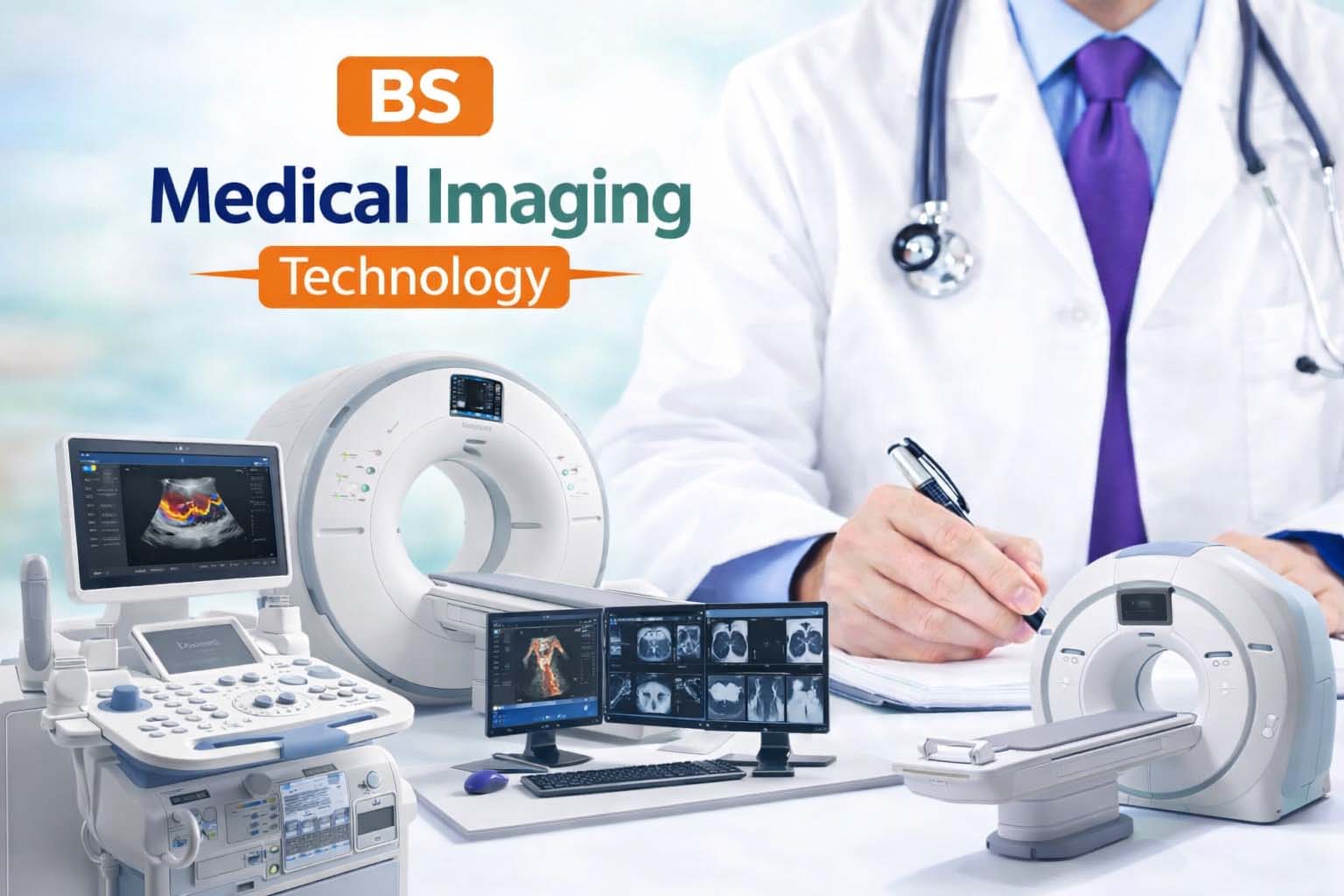
4 years Bachelor program
The Bachelor of Science in Medical Imaging Technology program is an undergraduate radiology program. The purpose of this program is to equip the students with relevant professional knowledge, skills, techniques and ethical values to enable them to apply their acquired expertise at a level between the doctors and the patient for efferent health service delivery. It is based on the techniques and processes used to create images of the human body or parts and function thereof of clinical purposes (medical procedure seeking to reveal/ diagnose or examine disease) or medical science including the study of anatomy and physiology. This program combines the clinical applications with training in the underlying science and technology of image formation in several diagnostic techniques; it also combines the key themes of, understanding how medical images are formed and appreciating what images reveal in the clinical context.
Program Goals:
The BS MIT program aims to:
1. Prepare graduates for competent professional practice by developing both core and advanced imaging skills
2. Prepare graduates who can ensure patient safety and comfort
3. Develop a professional identity and leadership skills
4. Develop accuracy and meticulousness to attain high levels of ethics and technical proficiency
5. Access the technical and non-technical skills in a standardized and reproducible environment
6. Strengthen the decision power and exercise appropriate judgment skills, to be applied especially and during crisis
7. Develop and analyze innovative strategies for effective communication with the patient and the health care personnel
8. Demonstrate inter disciplinary team building strategies or effective co-ordination between various allied health disciplines
9. Demonstrate understanding of the basic concepts of professional behaviors and legal implementations of work environment
Program Objectives
The graduates will:
1. Provide quality images using routine as well as advanced imaging procedures in order to improve diagnostic accuracy and patient care
2. Use digital imaging and information technology equipment competently, through application of the principal and theories of its operation in order to Identify diseases (infections, cancer), injuries (fractures, internal damage), and abnormalities (tumors, blockages) early and accurately.
3. Evaluate performance characteristics of equipment
4. Implement an effective radiation protection program
5. Apply the knowledge of sectional anatomy to relate clinical procedures, facilitating timely interventions and improving patient outcomes
6. Demonstrate an understanding of the principles of exposure selection and image processing, and an ability to apply this knowledge


· FSc (Pre Medical) or recognized equivalent qualification with a minimum of 50% marks
Age less than 24 years
Assessment Criteria
Midterm/Sessional Exam in 9th weeks
Final Term/Terminal Exam in 18th weeks
| Assessment of subjects with VIVA | % | |
|---|---|---|
| a) | Assignments | 10% |
| b) | Sessional Exam | 30% |
| c) | Final Exam | 40% |
| d) | Viva/Practical/OSPE/OSCE | 20% |
| Assessment of subject without VIVA: | ||
| a) | Assignments | 10% |
| b) | Sessional Exam | 40% |
| c) | Final Exam | 50% |
| Supervised Clinical Practice | ||
| Case Evaluation & Treatment | 70% | |
| VIVA | 20% | |
| Log book | 10% | |
| Research Project | ||
| Supervisor | 40% | |
| Synopsis | 30% | |
| Thesis Defense | 30% | |
| Passing criteria Cumulative | 50% | |

Entry Test will be Multiple Choice Questions (MCQs) based containing 50 MCQs of Total 50 Marks. There will be no Negative Marking and applicants will be given a time period of 1 hour to answer 50 MCQs. Following are the Detailed Division of Total
MCQs
• Biology: 15
• Physics: 15
• Chemistry: 15
• General Knowledge/English: 05
The final Selection is strictly based on Merit as per of following selection Criteria:
• F. Sc Marks 40%
• Matric 10%
• Entry Test 50%
Reference Books
Applicants are advised to use Text Books of F.Sc for the Purpose of preparation for entry test.
Sample MCQs:
Following are some Sample MCQs for Entry Test Exam.
BIOLOGY
1. Which bacteria can rarely have flagella
A. Spirilla
B. Diplobaccili
C. Cocci
D. Vibrio
2. Which of the following is not endotherm
A. Bird
B. Flying insect
C. Amphibian
D. Mammals
PHYSICS
1. A stone thrown from the top of a tall building follows a path that is:
A. Circular
B. Hyperbolic
C. Straight line
D. Parabolic
2. Strain can be measured in:
A. N/m2
B. N•m2
C. N/m
D. None of theses its unit less
CHEMISTRY
1. Units of gas constant R in SI system is:
A. 0.0821 dm3 atm k–1 mol–1
B. 82.1 cm3 atm k–1
C. 8.31 Nm k–1 mol–1
D. 1.987 cal k–1 mol–1
2. Boiling point is low for liquid with
A. High vapour pressure at given temperature
B. Low vapour pressure at a given temperature
C. Very high vapour pressure
D. Very low vapour pressure
ENGLISH
1. Choose the correct synonym of Acquiesce
A. Dissent
B. Assent
C. Oppose
D. Disagree
GENERAL KNOWLEDGE
1. Pakistan’s national animal is
A. Lion
B. Markhore
C. Rabbit
D. None of these